


Why Regenerative Farms Need Animals

In earlier posts in this series, we explored why soil health sits at the foundation of regenerative farming at Seven Hills Estate, and how biodiversity strengthens the resilience of the whole system. The fourth principle — integrating farm animals — brings these elements together.
Across natural grassland ecosystems, grazing animals have always shaped the landscape. Their movement stimulates plant growth, cycles nutrients, and influences which plant species thrive in a pasture. Regenerative farming works with these natural processes rather than trying to replace them.
At our farm here in Conondale in the Sunshine Coast hinterland of SE Queensland, livestock are not simply part of production. They are part of the ecological system that helps keep the land functioning.
Grazing as landscape management
One of the most important lessons in regenerative grazing is that how long animals stay on a paddock often matters more than how many animals are there.
Leaving livestock in the same paddock for long periods weakens pasture plants. The grasses animals prefer are repeatedly eaten before they recover, while tougher or less palatable plants gradually take over.
Instead, animals are rotated through a sequence of paddocks, allowing each area time to rest and recover before it is grazed again.
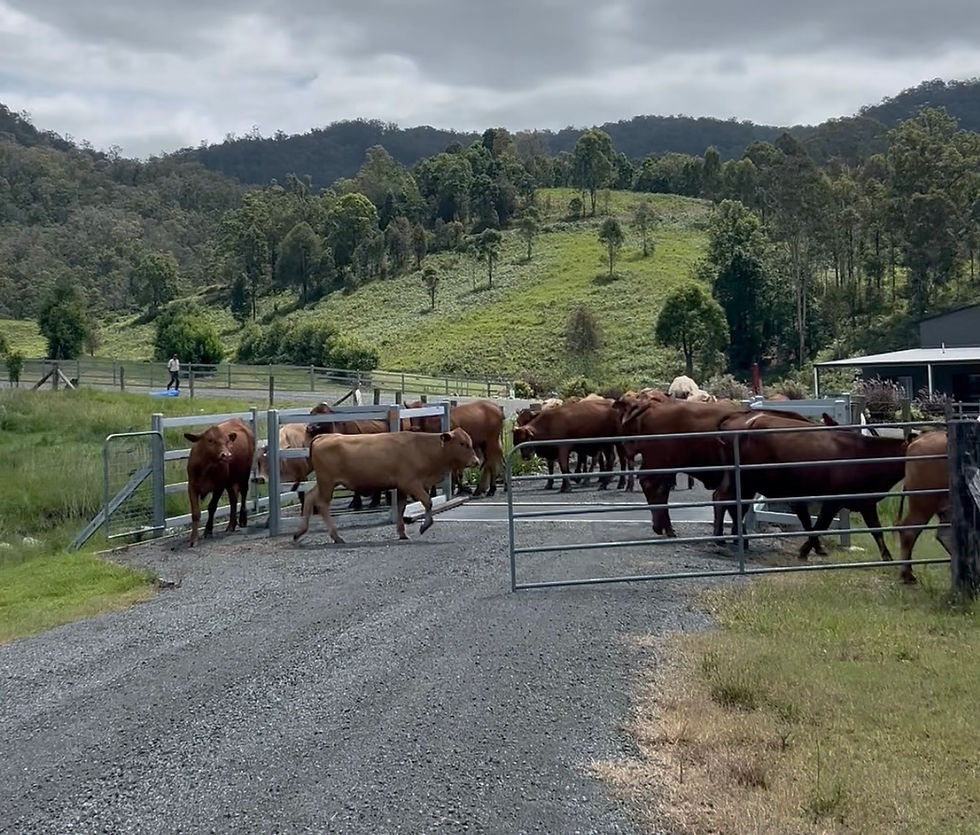
This approach reflects the work of grazing ecologist Allan Savory, who showed that properly managed livestock can help restore degraded grasslands by mimicking the movement of natural herds across a landscape. Concentrated grazing followed by adequate recovery allows plants to regrow, deepen their roots, and rebuild soil structure.
Many of these ideas became clearer to me during a week-long grazing management course with RCS Australia, founded by Dr Terry McCosker. One idea that stayed with me was McCosker’s observation that the management of animals is really the management of grass.
When pasture receives sufficient recovery time, it becomes stronger, more diverse, and more resilient during dry periods. The changes often begin underground, as root systems deepen and soil biology becomes more active.
Different animals, different roles
Each animal species interacts with the land in a slightly different way. At Seven Hills Estate we currently run cattle, sheep, and a small flock of laying chickens.
Cattle graze taller pasture grasses and return nutrients through manure and urine.
Sheep graze more selectively and help manage emerging weeds.
Chickens scratch through manure and organic matter, spreading nutrients and reducing insect populations.
The laying hens also rotate through sections of our syntropic food garden. There they forage for insects while fertilising the soil, helping maintain a healthy balance without disturbing the mulch layers that protect soil life.
In the future we plan to experiment with pigs in carefully controlled areas where their rooting behaviour may help break up dense patches of blade grass and accelerate the breakdown of organic matter. Used selectively, they can assist with ecological renewal in places where gentle disturbance is beneficial.
Letting animals guide decisions
Animals can also provide valuable feedback about the landscape. One example is our mineral self-selection station — sometimes called a “Cow Café”. Instead of offering a single blended mineral supplement, cattle are given several options and allowed to choose what they need.
Over time, these preferences can reveal subtle shifts in pasture condition and soil mineral balance. Changes in mineral selection often reflect shifts happening in the pasture long before they are visible to the eye.
Paying attention to these signals helps guide future management decisions.
The four principles working together
Over the past few articles we have explored the four principles that guide regenerative farming at Seven Hills Estate.

Promoting soil health
Fostering biodiversity
Managing water effectively
Integrating farm animals
None of these principles works in isolation. Soil health supports biodiversity. Biodiversity strengthens the water cycle. Animals connect plants, soil, and nutrients into a living system.
Regeneration happens when these relationships begin working together again.
At Seven Hills Estate we are still early in that journey. Each season reveals something new about how this land responds when given time to recover.
This five-part series only scratches the surface of regenerative farming here in the Conondale valley. In future posts we will continue sharing what is working, what is challenging, and what this landscape is teaching us.
Learn more
If you’d like to see these ideas in practice, we share much of this journey on our YouTube channel Life’s Better on the Farm, including our episode on regenerative farming.
For a deeper dive, you can also download our full regenerative farming white paper:


Comments